Payroll Tax R&D Credit for Qualified Small Businesses
Startups with no taxable income can now claim R&D credits directly against payroll taxes.

Payroll costs hit a startup's bank account the same week the offer letter goes out, whether or not the company has booked a dollar of revenue. Social Security and Medicare taxes come due on every paycheck, profitable or not. The R&D payroll tax credit exists because the standard version of this credit, applied against income tax, does nothing for a company with no income tax bill to offset. For a qualifying small business, the credit converts research spending into a direct reduction of payroll tax payments, up to $500,000 a year since the Inflation Reduction Act doubled the cap for tax years starting after December 31, 2022.
Congress didn't build this mechanism overnight. The R&D credit dates back to 1981, spent decades as a temporary provision renewed on a schedule, and became permanent under the PATH Act of 2015. The payroll tax offset came later, aimed at the population the original credit structure ignored entirely: pre-revenue companies pouring money into engineering and product work with no taxable income against which to claim anything. Most founders assume the credit is an income-tax play first and a payroll-tax afterthought. For a young company burning cash, that assumption gets the priority backwards. What follows is the operating detail: who qualifies, what expenses count, how the math works, and what the IRS now expects on paper.
What it means to be a Qualified Small Business and the five-year window
The statute, IRC Section 41(h)(3), sets two conditions for Qualified Small Business status, and both have to be true at once. Gross receipts in the current tax year must fall under $5 million. And the company must have no gross receipts in any tax year that started more than five years before the credit year in question.
That second condition trips people up because it has nothing to do with incorporation date. The five-year clock starts the first year the company had gross receipts. A company can sit dormant, or pre-revenue, for years after founding and still have a fresh five-year window once revenue actually starts.
Two examples make the distinction concrete. A company founded in 2022 that brings in $2 million in 2026 qualifies: its revenue history began around 2022, well inside the five-year window measured back from 2026. A company founded in 2015 that brings in only $1 million in 2026 does not qualify, despite the far smaller revenue figure, because it had gross receipts more than five years before 2026. The five-year test fails regardless of how modest the revenue has stayed. Age beats size here, and founders who assume otherwise find out the hard way at filing time.
Eligible entity types run wide: C corporations, S corporations, partnerships, LLCs, and other pass-through structures can all qualify, provided they meet the receipts and time tests. Tax-exempt organizations under Section 501 are excluded outright, no matter how much qualifying research they perform.
What research activities and expenses qualify under the four-part test
Qualification runs on what the work actually involved, not on what industry the company claims or how the project turned out. A failed prototype that never ships still generates qualified research expenses if the work meets the standard. The IRS doesn't score outcomes. It scores process, because a project that fails completely can still produce a real credit.
That process gets judged by the four-part test, applied separately to each business component: each product, process, technique, formula, or piece of software under development.
Part one asks about purpose: does the work aim to develop or improve a business component's function, performance, reliability, or quality? Cosmetic redesigns don't clear this bar, and neither does marketing research or a customer survey, however rigorously conducted.
Part two asks about uncertainty. At the start of the project, did the company genuinely not know whether it could achieve the result, or how, or what design would work? If the answer sits in a textbook, a manual, or a competitor's public documentation, the work is implementation, and it fails here.
Part three requires a process of experimentation: substantially all of the activity has to involve evaluating alternatives through modeling, simulation, systematic trial and error, or formal scientific experimentation. Iterative software development, the kind that cycles through hypothesis, test, and refinement, fits naturally into this category.
Part four requires that the work be technological in nature, grounded in physical science, biological science, engineering, or computer science. Social science research, market analysis, and aesthetic or stylistic design fall outside the definition, however analytical the process behind them looks.
Manufacturing, software development, construction, engineering, and agriculture appear often among companies that clear this test, but the IRS publishes no approved list of qualifying industries. There is no industry checklist to consult. The four-part test is the only standard that matters, and it gets applied fact by fact, project by project, component by component.
Internal-use software, meaning software built for the company's own back-office or operational use rather than for sale, has to clear a higher bar: real innovation and substantial improvement in speed, efficiency, or cost measured against whatever's already commercially available. Dual-function software, built partly for internal use and partly for a third party, gets its own separate treatment under the regulations rather than falling neatly into one category or the other. New applications, meaningful upgrades to existing functionality, and cloud-based development tools can all potentially qualify, provided the underlying work still satisfies all four parts of the test.
Calculating the credit before the payroll tax offset
The R&D credit reduces tax liability dollar for dollar. A $50,000 credit cuts $50,000 off the bill, full stop, not $50,000 times whatever the marginal rate happens to be. That distinction matters because credits and deductions get conflated constantly, and the gap between them separates a rounding error from a meaningful cash event.
Federal credits generally run between 5% and 10% of qualified research expenses, with the exact figure depending on which calculation method the company picks and how much QRE history it has on file. Small businesses tend to land closer to 6% to 8%.
Two methods exist, and a company has to choose one and stick with it consistently across filings. The Alternative Simplified Credit, or ASC, sets the credit at 14% of QREs that exceed 50% of the average QREs from the prior three tax years. It requires less historical data, so it covers most filers. The Regular Credit runs at 20% above a fixed historical base amount, but that base period has to be documented, and for a startup without years of QRE history behind it, the Regular Credit rarely produces a better outcome.
Early-stage companies do better under ASC precisely because their three-year average QRE is small, sometimes nonexistent. A small average means a small 50% threshold, and more of the current year's QREs end up counted toward the 14% credit rate. Anyone advising a young company to run the Regular Credit calculation first is wasting a client's time.
How the payroll tax offset election works and when the benefit arrives
The offset applies against the employer's share of payroll tax specifically, in a fixed order set by statute, not one the taxpayer gets to pick.
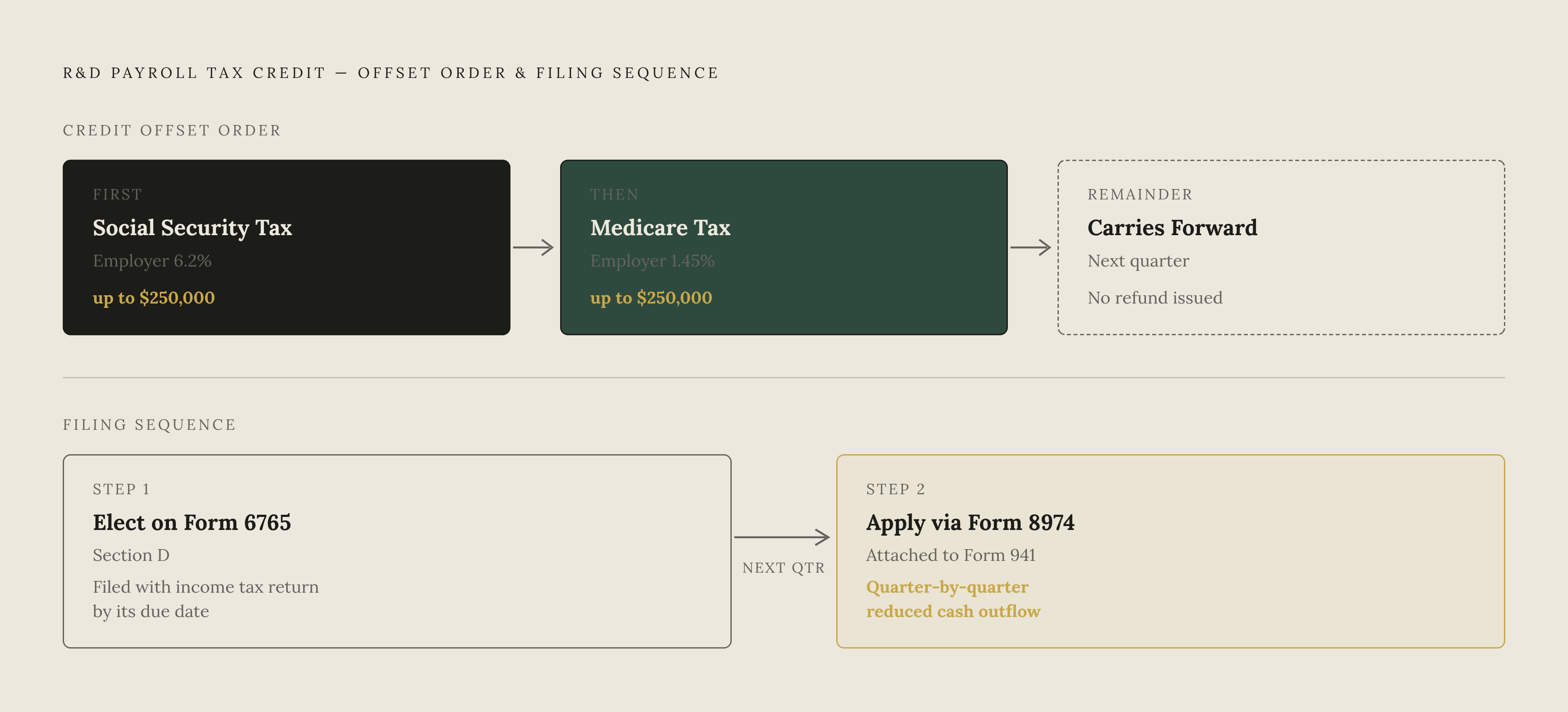
The credit first offsets the employer's 6.2% Social Security tax, up to $250,000. Once that's exhausted, any credit still remaining offsets the employer's 1.45% Medicare tax, up to another $250,000. Whatever's left after both of those get consumed carries forward into the next quarter instead of disappearing or being refunded.
No check arrives in the mail. The benefit appears as a reduction in the payroll tax payment due each quarter: less cash goes out the door, rather than more cash coming in. Economically the two are identical, but the mechanism is a lower outflow, not an inbound deposit, and that distinction matters for anyone modeling cash flow month to month.
Claiming it takes two separate filings, done in sequence. First, the election itself gets made on the income tax return, by completing Section D of Form 6765 and filing it on or before the original due date, extensions included. This election must be made on a timely filed return, which means missing the original deadline puts the option for that year at serious risk. Second, once the election is in place, the credit gets reported and applied quarter by quarter on Form 8974, Qualified Small Business Payroll Tax Credit for Increasing Research Activities, which attaches to the quarterly Form 941.
Timing carries real consequences here. The earliest quarter a business can start applying the credit is the quarter that begins after the income tax return gets filed, not the quarter the return covers. A startup that files its 2025 return on March 15, 2026, can start offsetting payroll taxes beginning in Q2 2026, not before. Filing earlier in the season, rather than waiting until the deadline, pulls that start date forward and gets cash relief flowing sooner. That's one of the few levers a company actually controls in this whole process, and it's an easy one to leave on the table by filing late out of habit rather than necessity.
The redesigned Form 6765 and what QSBs must complete for 2025 and 2026
Form 6765 underwent a significant redesign, with the IRS releasing finalized instructions on February 6, 2026, covering the tax year 2025 filing season. The redesign moves the form away from summary-level reporting and toward disclosure at the level of the individual project and business component, a shift that Shay CPA, in guidance the firm provided to other CPAs, described as demanding richer narrative disclosures, more granular cost allocations, and expanded reporting on controlled groups.
The centerpiece of that shift is Section G, Business Component Information, and its rollout happens in two stages. For tax years beginning before 2026, Section G stays optional for every filer. For tax years beginning after 2025, it becomes mandatory for most filers, a hard deadline that gives companies a limited runway to build the recordkeeping habits Section G assumes are already in place.
When Section G applies, taxpayers report business components in descending order of cost, continuing until they've captured either 80% of total QREs or 50 components, whichever comes first. Wages reported within Section G can't be lumped together either. They have to be split into three distinct categories, direct research, supervision, and support, each tracked separately per component.
A taxpayer who qualifies as a QSB and elects the payroll tax offset can skip Section G completely. Given how much additional documentation Section G demands elsewhere, that exemption is a meaningful compliance advantage for small companies that would otherwise be tracking business-component-level cost data they don't yet have systems built to produce.
Documentation standards the IRS expects and the origin of audits
Audit risk on this credit isn't evenly distributed. Filing an amended return that suddenly adds a large R&D credit not present on the original filing is a well-known audit risk trigger in this program. A credit that shows up for the first time on an amendment draws attention precisely because it wasn't part of the original story the return told.
For R&D credit refund claims filed on amended returns postmarked after June 18, 2024, the IRS requires three specific categories of supporting information up front, not on request. The claim has to identify all business components the Section 41 credit relates to. It has to describe, for each of those components, what research activities were actually performed. And it has to state the total qualified employee wage, supply, and contract research expenses claimed for that year.
Missing pieces aren't necessarily fatal on the spot. The IRS allows a 45-day perfection period during which a taxpayer can supply information missing from an otherwise incomplete amended refund claim, and that transition process runs through January 10, 2027. After that date, the leeway goes away, and claims arriving without the required detail face rejection rather than a chance to fix the gap. Build the documentation trail as the research happens, not after the return's already been amended and the IRS is asking questions about it. Waiting until the audit letter arrives to reconstruct which engineer worked on which component, in which quarter, is how a legitimate credit turns into a denied one.
Sources
- Instructions for Form 6765 (12/2025) | Internal Revenue Service
- R&D Tax Credit 2026: Rates, Eligibility, How to Claim | Strike Tax
- Research credit against payroll tax for small businesses | Internal Revenue Service
- Using the R&D Credit for Your 2026 Payroll Taxes - Shay CPA
- Startup R&D Tax Credit: Payroll Offset Guide for 2026 | Strike Tax
- irs.gov